Product Design · Mobile · 0 -> 1 Product Strategy
Launching a mentorship mobile app that leads to 300+ matches and 9 point average MCAT score increase for pre-med students.
DURATION
Jul 2021 - Jan 2022
TEAM
1 Co-founder, 3 PMs, 5 devs
ROLE
Lead Product Designer
UX Researcher
The problem
Minority pre-med students lack access to mentorship and structured tracking. As a result, they struggle to navigate application prep and report low confidence and acceptance rates.
PathLeap's mission
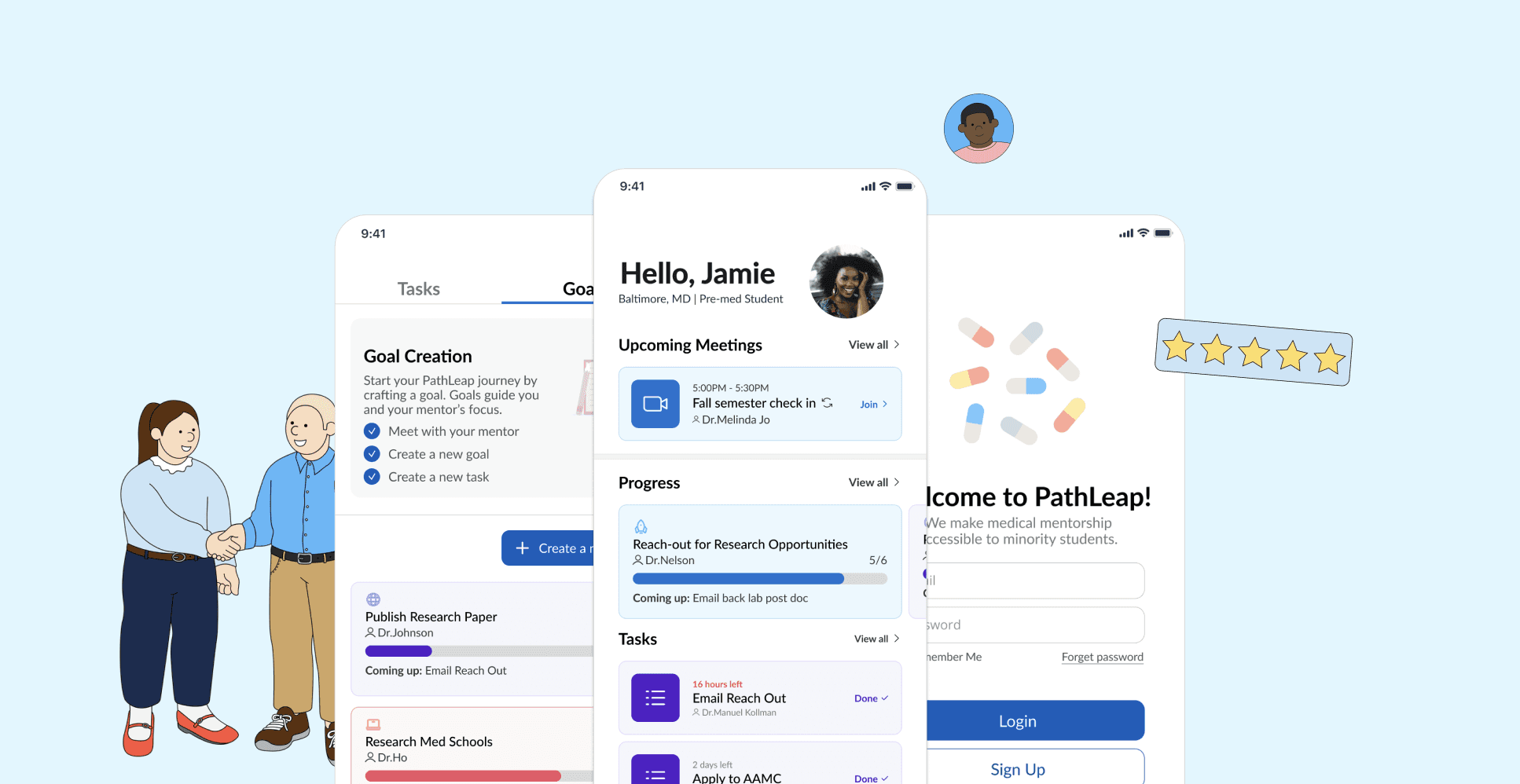
Empower minority pre-med students on their journey by helping them find professional mentors and build long-lasting connections.
My impact
300+
Matches created in the first month.
8 goals
Completed per user-mentor duo.
+9 points
Increase on users' average MCAT practice score.
Project timeline
We iterated fast by actively testing designs in front of real users to validate hypothesis and pivot whenever necessary in five months.

Business goals


Grow active users
KPI: sign-ups to activation rate
Increase retention
KPI: weekly active users, tasks/goals completion rate
Accelerate outcomes
KPI: GPA/MCAT score increases
Since no one on the team has a pre-med background, I led six 45-minute qualitative interviews with pre-med students.
Users need mentors because
#1
Unfamiliarity with the field
“I’m hesitate to pick the pre-med route because I don’t know what it’ll take to become a doctor.”
—Kaitlyn, undergrad freshman
#2
Lack exposure to info
“My school’s career center lacks useful resources that can help me prepare for med school.”
—Amy, undergrad sophomore
#3
No professional guidance
“I feel lost when finding summer/on-campus research. I simply don’t know where to start.”
—Chun, undergrad sophomore
Originally, stakeholders only had a vague idea of a mentor matching app, but research showed this wouldn’t solve the bigger problem.
I made a quick but high-impact decision to expand scope to cover mentorship tracking and engagement.
Mentorship is hard to maintain
#4
Mentor compatibility
"I want my mentor to match my untraditional background, vibe, interest and timezone."
—Edgar, graduated Senior
#5
Progress is intangible
"Progress is very hard to track. I wish my mentee can stay on the same page with me."
—Lesley, pediatrician
#6
Building a connection
“I prefer a mentor who shapes my growth mindset. It's all about building a relationship.”
— Amy, undergrad sophomore
#1
Optimize user-mentor pairing.
WHY IT MATTERED
Poor mentor fit causes short-term engagement.
WHAT I DID
- Gathered & ranked key attributes users look for in a mentor
- Designed mentor discovery workflow
- Worked with engineers to test and iterate on experience
1-1 Maximize fit in mentor matching

I designed questionnaires aimed for under 5-minutes during signup and mentorship activation to gather user information such as education, program goals, focus areas, time zones, and availability. This powered my engineers to produce stronger recommendations.
#2
Help users track and record their progress with clarity.
WHY IT MATTERED
Users and mentors are motivated by tangible progress.
WHAT I DID
- Developed the concept of Goals and Tasks
- Designed a personalized tracker
- Enhanced first time user experience
2-1 Building an intuitive progress tracker

Users often set large goals like “complete the MCAT,” but lacked ways to break them into steps. I introduced a Goals & Tasks model, where large goals were broken into smaller, measurable tasks.

Goals & Tasks [Low-fi]
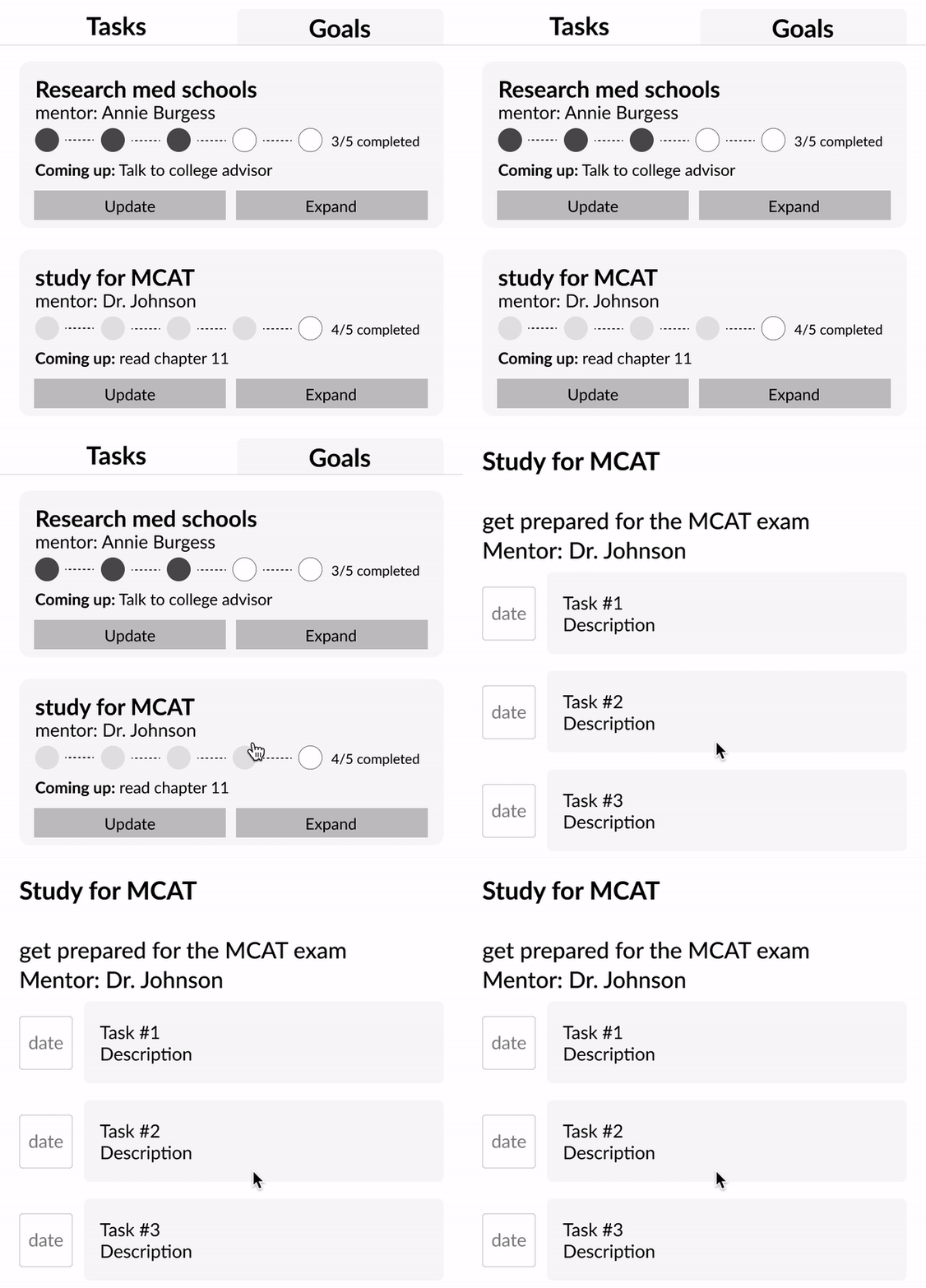
Goals [Mid-fi]

Tasks [Mid-fi]

After usability testing, I switched the dots to progress bars for better scalability and comprehension without delaying handoff.
2-2 Task card behaviors

2-3 Lead the way for new users
During research, users showed difficulties picking up the tracker. In a day, I designed three onboarding popup versions and did 4 quick tests. The explicit step-by-step option won and significantly improved adoption.

💡 Instead of redesigning the whole tracker, I solved the problem with lightweight onboarding
#3
Foster long term relationship between users and mentors.
WHY IT MATTERED
Authenticity leads to long-term success.
WHAT I DID
- Created psychology driven design
- Identified a series of interaction opportunities
3-1 How to ask for help
Research showed trust grows not just from giving help, but asking for it. How do i design reciprocity?
“You build trust not when you offer help, but when you ask for help.”
—Simon Sinek
3-2 Opportunity #1: Mutual selection

Mutual opt-in gives mentees and mentors the selection agency preserved dignity and increased long-term engagement. Feedback from v1 showed lower initial match rate is worth the higher post-match retention.
3-3 Opportunity #2: Mutual approval
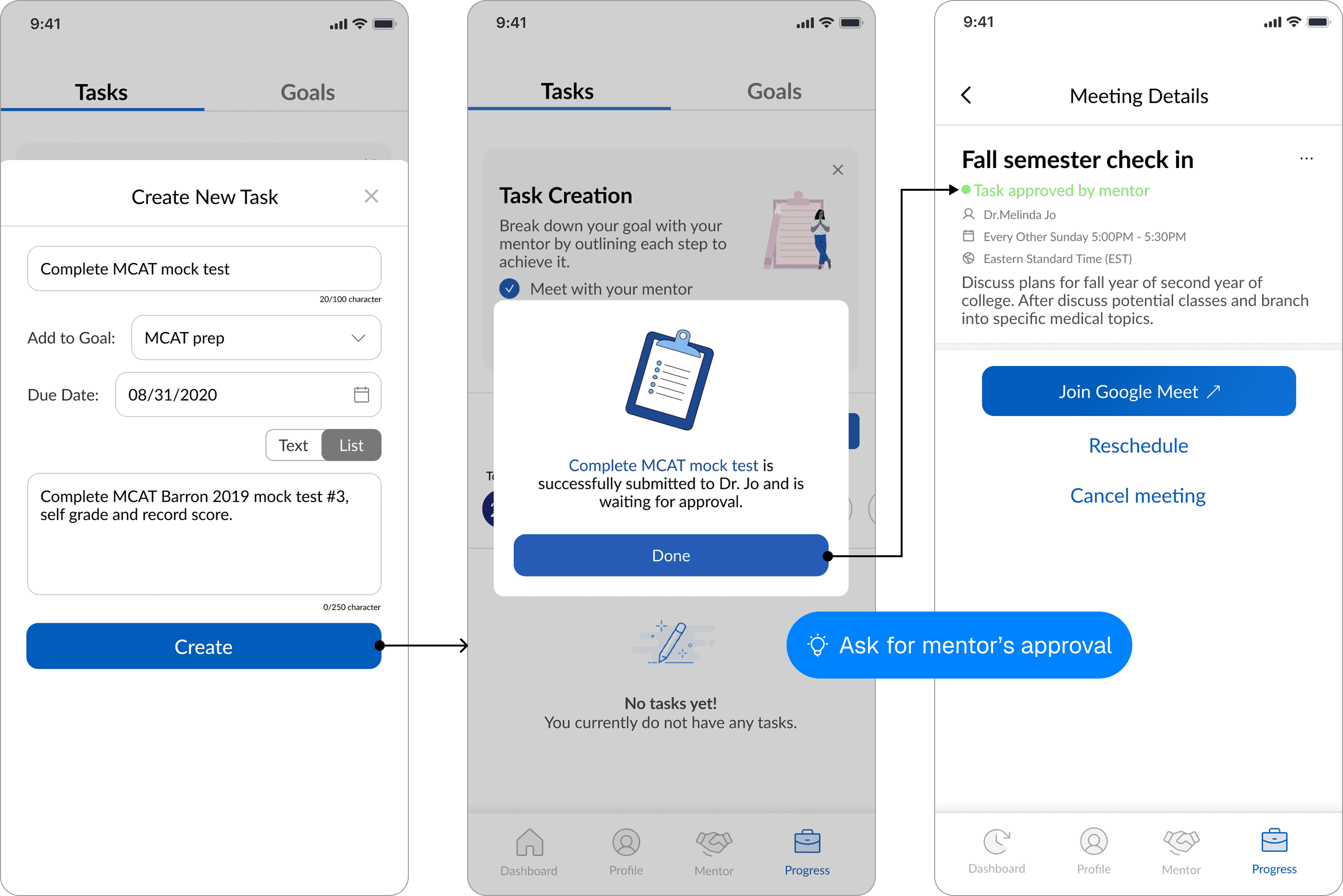
Collaborative task creation where some goals require approval from mentors. This increased transparency and alignment.
3-4 Opportunity #3: Mutual feedback

I designed a lightweight feedback survey at the end of each meeting that's automatically triggered to encourage authentic responses without intimidating users. I tested different survey lengths and adopted the 3-question version because it balanced depth with completion rate
Designing visual language
To accelerate shipping and maintain consistency, I built a lightweight design system with tokens and 8 reusable components.

Product Overview

Seamless Onboarding
User's education level, program focus, and time zone information are collected to help build a profile and later match with mentors.

Dashboard to Keep Up to Date
The one-stop Dashboard keeps track of the user's upcoming events, goal progress, incentive to pick-up a goal, and useful resources.

Edit a Task & Mark as Complete
The tasks remain versatile and editable to best suit the user's noting needs.

Matching with the Perfect Mentor
Users can browse available mentors and compose a personalize message for mentorship request.

Goal Setting
Mentors and mentees foster relationship and stay on track by completing mutually approved goals. Goals point the mentors and mentees towards a clear direction they will focus towards.

Task Crafting
Goals are broken down into clear steps known as 'tasks,' which contain deadlines and work descriptions.
Lessons & Challenges


Believe in my designs
Building with constraints
Know when to ship
If I had more time, I’d experiment with retention levers like mentor incentives, milestones, and formalize outcome tracking across a larger cohort to strengthen the business case. but overall, I'm very proud of the final product and see my work has real impact on real people!

